Updated on 1 Oct 2026
A clogged drain line is the cause of roughly seven in ten cases of aircon leaking water in Singapore homes, and it is almost always fixable without replacing parts. But a small drip can share symptoms with a cracked drain pan, a frozen coil, or a faulty condensate sensor, and each carries a different risk and repair cost.
This guide covers the nine common causes of an aircon leaking water, tags each with an urgency level (safe to wait, call this week, or stop using immediately), and gives realistic repair costs for each in Singapore. It draws on patterns across 650,000+ units we have serviced since 2011.
What should I check first when my aircon is leaking water?
Check two things: where the water is coming from, and what colour it is.
These two observations narrow the nine possible causes down to one or two, and tell you whether you can keep using the unit or to switch it off immediately.
- Clear water dripping from the front of the indoor unit almost always points to a clogged drain line.
- Water running down the wall behind the unit usually means a disconnected or incorrectly sloped drain pipe.
- Brown or rust-tinted water points to a cracked or corroded drain pan and is a stop-using-immediately signal.
In addition, look at whether the water is reaching a plug, wall socket, or any electrical part of the unit. If it is, switch off now.
| What you see | Most likely cause | Urgency |
|---|---|---|
| Clear water from front of indoor unit | Clogged drain line | Safe to wait 24 hours |
| Water running down wall behind unit | Disconnected or sloping drain pipe | Call within a week |
| Brown or rust-tinted water | Cracked or corroded drain pan | Stop using immediately |
| Ice visible on coil or vents | Frozen coil (dirty filter or low gas) | Stop using immediately |
| Water near plug or wall socket | Any cause, now an electrical risk | Stop using immediately |
| Leak only after a recent service | Reassembly issue | Call the servicer within 48 hours |
The 9 common causes of an aircon leaking water in Singapore
Nine causes account for nearly every case of an aircon leaking water we see in Singapore homes. Three of them (clogged drain line, dirty filter, and frozen coil) account for roughly 85% of residential leaks. The remaining six are less common but carry higher urgency when they do occur.
1. Clogged drain line
Urgency: Safe to wait 24 hours
A clogged drain line is the cause of roughly seven in ten aircon leaks we are called out for in Singapore homes, and the reason is dust and biofilm. Condensation carries dust from the evaporator coil down the drain pipe.
In Singapore’s year-round humidity, this dust combines with moisture to form a slimy biofilm that narrows the pipe. Once the pipe slows enough, water backs up into the drain pan and overflows at the front of the indoor unit. You will usually see clear water dripping from the front panel, often with a slight delay after the unit starts running.
Can you DIY: Yes. The fix is straightforward for most homeowners: flush the drain line from the outdoor end using a wet-dry vacuum (see the DIY section below).
Typical cost: $50 to $100 as a standalone drain-clear, or bundled into a full aircon chemical wash if the pipe interior is heavily fouled.
If the drip continues after you flush, an aircon technician can trace the blockage further in and clear it in one visit.
2. Dirty air filter
Urgency: Call within a week
When the air filter is clogged with dust, airflow over the evaporator coil (the cold metal fins inside the indoor unit where condensation forms) drops. With less air moving across it, the coil gets too cold and frost builds up. When the unit switches off, the frost melts all at once and overwhelms the drain pan.
Spot it by pulling out the filter and holding it up to light. If you can barely see through it, then it is dirty. Most filters in Singapore need a rinse every two to four weeks given how much dust and haze we deal with.
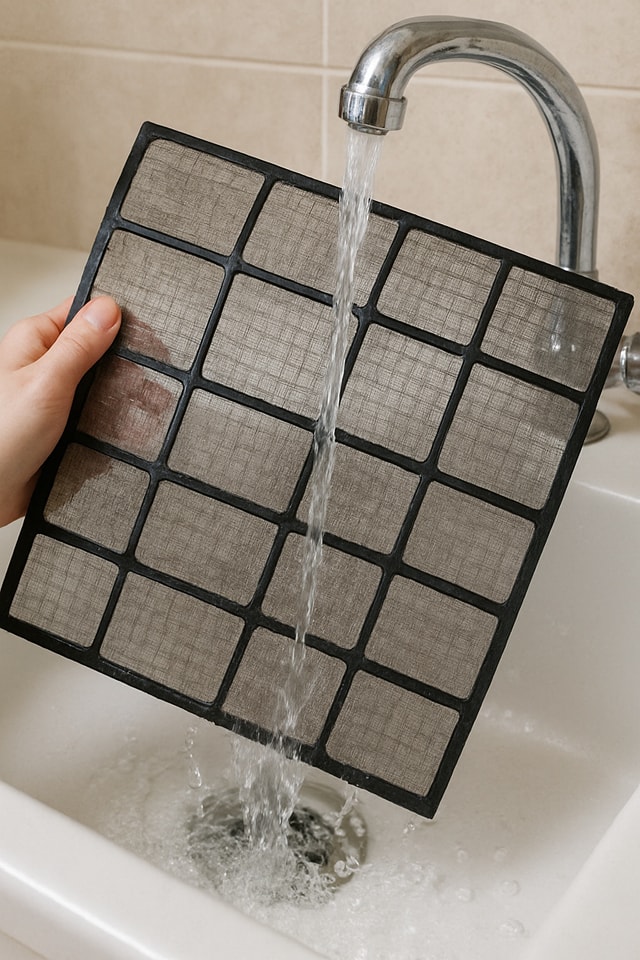
Can you DIY: Yes, safe to DIY. Rinse the filter under running water, let it dry fully, and slide it back. No tools needed.
Typical cost: Free if you DIY, or covered under a routine quarterly aircon servicing visit starting from $50 for the first unit.
If the leak keeps coming back even after cleaning the filter weekly, an aircon technician can inspect the coil and airflow path for deeper issues.
3. Frozen evaporator coil
Urgency: Call this week. Switch off to let it thaw.
A frozen evaporator coil means ice is forming on the fins where air passes through. When the unit cycles off or the ice gets thick enough, it melts into water that overflows the drain pan.
The two most common causes are a dirty filter (see cause #2) and genuinely low refrigerant (cause #4).
Some homeowners are told they need a gas top-up when the real issue is a frozen coil caused by a dirty filter. If your unit leaks only after running for an hour and you can see frost on the vents, ask for a filter-and-coil inspection first.
Can you DIY: No. Switch the unit off for two to three hours to let the ice melt fully before a technician arrives, otherwise they cannot see what they are diagnosing.
Typical cost: $140 to $160 for a chemical wash that resolves most dirty-coil cases, or $75 to $120 for a gas top-up if refrigerant is genuinely low. If frost returns within a few days of either fix, an aircon technician can test for a refrigerant leak rather than just topping up again.
4. Low refrigerant or gas leak
Urgency: Call within a week
Refrigerant is what allows the evaporator coil to get cold. When it leaks out slowly, coil temperature drops below the point where condensation forms properly, ice builds up, and the unit starts leaking water instead of just condensing it. Low refrigerant also makes the unit feel less cold and run much longer to reach temperature.
The tell-tale sign is a unit that used to cool a room in 15 minutes now taking 40 minutes or more, with a leak that only shows up after extended running. If you see oily residue near the pipe connections behind the indoor or outdoor unit, that is refrigerant oil and confirms a leak point.
Can you DIY: No. Refrigerant handling is regulated in Singapore as it needs proper gas handling tools and a licensed technician.
Typical cost: $75 to $120 for an R32 gas top-up, more for older R410A systems. If the unit needs a top-up again within six months, a trained aircon technician can pressure-test the system to locate and seal the actual leak rather than keep topping up.
5. Dirty evaporator coil (biofilm)
Urgency: Safe to wait 24 hours, but plan the fix
Even when the filter is clean, the evaporator coil fins can build up biofilm over months of Singapore humidity. This layer stops condensation flowing down into the drain pan cleanly. The water beads up, drips forward over the pan edge, and you see what looks like a leak from the front of the unit.
You can sometimes see the biofilm by shining a torch through the front louvres while the unit is off. It shows up as a dull grey or greenish film on the fins. You will also often notice a faint musty smell from the aircon running alongside the drip.
Can you DIY: No. The coil needs to be chemically washed, which requires dismantling the indoor unit by a trained aircon technician.
Typical cost: $140 to $160 for a chemical wash. If the biofilm has been building up over a long time, an aircon specialist can strip the coil back to clean metal in a single chemical overhaul visit.
6. Disconnected or incorrectly sloped drain pipe
Urgency: Call within a week
The drain pipe runs from the indoor unit’s drain pan out to the external drain point. It usually runs through trunking (the enclosed casing that hides piping). It needs a slight downward slope the entire way. If the pipe has slipped out of its connection, or if the slope has reversed at any point, water pools and eventually escapes backwards.
You will see water running down the wall behind the indoor unit rather than dripping from the front. Sometimes there will be a damp patch spreading across the wall (or ceiling for cassette systems) over a day or two.
Can you DIY: No. Correcting pipe slope or reseating the pipe means opening the trunking and sometimes the indoor unit casing.
Typical cost: $80 to $150 for a straightforward reseating; more if trunking needs to be opened and resealed, especially in condo builds with concealed piping. If the leak started after a renovation or aircon move, an aircon technician can check whether the pipe run meets the required slope and fix it in one visit.
7. Cracked or corroded drain pan
Urgency: Stop using immediately
The drain pan sits under the evaporator coil to catch condensation. Over the years it can crack from accidental knocks during servicing, or corrode on units that have passed their working life. When it cracks, water bypasses the drain line entirely and drips out wherever the crack is.
The clearest signal is brown or rust-tinted water, which means the pan metal is degrading. If the pan is plastic, you may see a sudden increase in leak volume with no obvious trigger.
Can you DIY: No. Stop using the unit until the pan is replaced. A cracked pan on a running unit can drip onto the PCB (the printed circuit board controlling the unit) or the electrical harness inside the indoor casing.
Typical cost: $150 to $300+ depending on the brand and model, parts included. For units past ten years old, replacing the whole indoor unit sometimes works out more sensibly than a pan swap. An aircon specialist can inspect and quote both options before you decide.
8. Improper installation
Urgency: Call within a week
If your aircon has leaked since the day it was installed, or since a recent reinstallation after renovation, the installation itself is probably the cause.
Common issues: the indoor unit was not mounted level (so condensation pools to one side), the drain pipe slope was wrong from day one, or the pan was not seated correctly in its bracket.
Spot it by checking whether the indoor unit sits visibly level against the wall or ceiling. A spirit-level app on a smartphone works for a quick check. If one side is clearly higher than the other, that is likely the issue.
Can you DIY: No. The unit needs to be remounted and sometimes the trunking reopened.
Typical cost: $150 to $400+ depending on whether trunking needs to be reopened and resealed. If the unit is still within the installer’s warranty, go back to the original installer first. Otherwise, an aircon technician can assess the mounting and correct it in one visit.
9. Faulty condensate overflow sensor or float switch
Urgency: Call within a week
Many modern inverter aircon units have a small float switch inside the drain pan. When the water level rises too high, the switch cuts off the unit to prevent overflow.
If this switch fails in the “always open” position, it stops cutting off and water escapes. If it fails “always closed”, the unit trips for no reason and leaks a small amount each time before cutting out.
You will usually see this paired with an error code on the remote or a blinking LED pattern on the indoor unit. The leak itself is intermittent and tied to the error.
Can you DIY: No. The switch needs to be tested and swapped.
Typical cost: $80 to $150 for the part and labour, depending on the model. Units from the brands we service regularly use slightly different float switch designs.
10. Condensation on refrigerant pipes
Urgency: Call within a week
The thin copper pipes that run from the indoor unit to the outdoor unit carry very cold refrigerant. In Singapore’s humidity, warm air hitting a cold pipe turns into water on the surface, the same way a cold drink sweats in a glass. Insulation foam wrapped around the pipes stops this. When the insulation fails, the pipes sweat and the water drips onto the floor, the wall, or the ceiling below.
Three things cause this, and they are easy to mistake for a drain problem:
- Worn insulation. Foam cracks, flakes, or comes loose after years of heat and sun, especially on pipes outside the room. Bare patches sweat first.
- Bent or kinked copper pipes. A kink restricts refrigerant flow and can make the pipe colder than it should be. This can cause icing along the pipe, which then melts into drips. A dirty fan coil unit or low gas can cause the same icing (see causes #3 and #4).
- Holes not patched properly. Gaps around the pipe where it passes through the wall let warm, humid air reach the cold pipe. Gaps that are not sealed also let rain or outdoor moisture in.
The giveaway is water dripping along the pipe run, or damp patches on the wall or ceiling following the pipe route, while the drain line itself is clear. If water appears only after the unit has run for a while, ice on the pipes is a likely cause.
Can you DIY: No. Wrapped pipes can be checked by eye, but re-insulating, straightening, or re-sealing needs a technician. Do not bend or press on kinked copper yourself, as it can crack and leak refrigerant.
How can I DIY and fix a leaking aircon myself?
Three DIY fixes resolve the majority of aircon leaking water cases without a technician visit: clean the air filter, flush the drain line, and check the drain pipe slope.
1. Clean the air filter
Open the front panel of the indoor unit, slide out the filter, rinse it under running water, let it dry fully in the shade, and slide it back in.
2. Flush the drain line from the end
Find where the drain pipe exits (typically in the toilet or outdoors). Hold a wet-dry vacuum firmly over the pipe end and run the vacuum for 60 seconds. You should hear the blockage come through. Repeat once if needed.
3. Check the drain pipe slope
If part of the pipe is visible along the wall or ledge, eye it along its length. It should run downhill the entire way. If any section sags or rises, that is worth flagging to a technician.
If your aircon is leaking water right now, follow these steps in order:
- Switch off the unit.
- Place a towel under the leak.
- Take a photo of where the water is coming from.
- Remove and rinse the air filter.
- Flush the drain line from the outdoor end using a wet-dry vacuum.
What you should not DIY: Anything involving refrigerant, the sealed drain pan inside the indoor unit, opening the trunking, or working near the electrical connections. Switch off before you touch the unit.
If the leak continues, call an aircon technician.
When to stop using your aircon immediately
Switch off your aircon immediately in any of these three situations:
- Water is dripping onto a plug, wall socket, or any electrical component.
- The water is brown or rust-tinted.
- Water is pooling faster than a clean drain pan should produce.
One to two drops per minute is normal condensation; a steady stream is not. Running the unit in any of these states risks an electrical fault and can damage the PCB inside the indoor unit.
A damaged PCB turns a simple repair into a much bigger job. We have seen units where a $100 drain-line issue became a $600 PCB replacement because the owner kept running the unit for a week while water dripped onto the electronics.
If any of the three signals above apply, switch off now and book an aircon repair visit.
Why does an aircon leak matter more in Singapore?
In Singapore’s HDB flats and condos, an aircon leak can escalate into a neighbour-liability problem within hours, which is why it matters more here than in other countries.
Water that runs through the floor slab and appears on the downstairs ceiling often triggers an MCST claim or a building management report. The liability usually sits with the unit owner whose aircon caused the leak.
In a landed house, the same leak would be a nuisance you can clean up. In an HDB flat or condo, it becomes your downstairs neighbour’s problem within hours. This is why small aircon leaks tend to get expensive when ignored.
The common pattern we see: A small drip starts on a Monday, the owner plans to get it looked at over the weekend, and on Friday the downstairs neighbour reports water stains on their ceiling. At that point you are no longer just fixing an aircon. You are also dealing with a repaint, sometimes a contents claim, and a building management complaint letter. The aircon fix itself rarely changes. The surrounding cost does.
If you live in an HDB flat or condo, treating any unexplained leak as at least “call within a week” is sensible, even if the water looks harmless.
How to prevent aircon leaks
Three things prevent the vast majority of leaks.
1. Clean the filter every two to four weeks
Singapore humidity averages around 83% year-round, per NEA climate data. That is well above the 50 to 60% humidity most air conditioning manufacturer service intervals assume.
Dust accumulates faster on filters here than the manuals suggest. A filter rinse takes five minutes and prevents the dirty-filter and frozen-coil causes mentioned above.
2. Book quarterly aircon servicing
A proper quarterly visit clears the drain line before it clogs, checks the coil for early biofilm, and catches small installation or sensor issues before they cause leaks. Our quarterly service packages bundle four visits a year at a discount versus ad-hoc visits.
3. Do a chemical wash every 12 to 18 months
Quarterly servicing keeps the unit running well, but the coil itself still accumulates biofilm over time. A chemical wash strips the coil back to clean metal and resets the maintenance clock. Most Singapore homes, especially those near coastal areas or major roads and construction sites, benefit from a chemical wash roughly every 12 to 18 months.
Frequently Asked Questions (FAQ)
1. Is it safe to keep using my aircon when it is leaking water?
A small, clear drip from the front of the indoor unit is usually safe briefly. But if water is brown-tinted, pooling fast, or reaching the plug or wall socket, switch it off immediately.
Running the unit with a compromised drain pan can damage the indoor PCB and turn a small repair into a much larger one.
2. Why is my aircon leaking water after a recent service?
Usually the drain pan was not fully reseated, the filter was reinstalled slightly off, or the chemical wash dislodged a deeper blockage that then clogged further down the pipe.
Call the servicer within 48 hours. A reputable aircon service provider should return to recheck within the service warranty period at no extra charge.
3. Can my HDB town council or condo MCST fine me if my aircon leak damages a neighbour’s ceiling?
Liability usually sits with the unit owner whose aircon caused the leak, not the management. Home contents insurance may cover the repair, but the MCST or town council can log a complaint that leads to a demand letter.
Small leaks become expensive quickly when they reach a downstairs unit, which is why it pays to act on them early.
4. How long does a leaking aircon repair take in Singapore?
A drain line flush takes usually 30 to 60 minutes on site. A drain pan replacement or gas top-up adds another 60 to 90 minutes.
A leak caused by installation issues may need trunking to be reopened, which takes longer but is still usually a same-day job for most residential setups.
5. Can I clear the drain line myself?
Yes, if the outdoor end of the drain pipe is accessible from your toilet, balcony or service yard. Switch off the aircon, place a towel under the indoor unit, and use a wet-dry vacuum at the drain outlet to pull out the blockage.
If the leak continues after clearing, the blockage is deeper or the cause is different, and a technician visit is the next step.