A dirty air filter or wrong mode setting accounts for more “not cold” service calls than most people expect. But not all causes are that simple, and urgency varies sharply.
Some faults are safe to monitor for a day while you run basic checks. Others mean switching the unit off and calling a technician before you incur more damage.
In this guide, we organise common causes by urgency tier, based on our 14 years of servicing experience and over 650,000 units handled across Singapore.
Quick triage: which cause are you dealing with?
Before diving into each cause, check the table below. Every symptom maps to a likely cause and an urgency tier.
The three tiers are:
- Safe to monitor: you can run basic checks yourself today
- Call this week: needs a technician but is not an emergency
- Stop using now: continued running makes the fault worse and more expensive to fix
| Symptom | Likely cause | Urgency | First action |
|---|---|---|---|
| Running but blowing warm air, no other symptoms | Wrong mode or setpoint | Safe to monitor | Check remote settings |
| Weak airflow from indoor unit | Dirty air filter | Safe to monitor | Clean the filter |
| Unit runs but no cooling, no ice or noise | Low refrigerant (gas leak) | Call this week | Book a gas check |
| Outdoor compressor running but no cooling | Dirty condenser or compressor fault | Call this week or stop, depending on noise | Book inspection |
| Cold at first, warms up after 30 minutes | Frozen evaporator or low refrigerant | Stop using now | Power off, call a technician today |
| Ice visible on coils | Frozen evaporator coil | Stop using now | Power off, call a technician today |
| Buzzing sound, tripped circuit breaker | Electrical fault (capacitor, PCB or wiring) | Stop using now | Power off, call a technician today |
The reason urgency matters is simple: running a unit with an electrical fault or a frozen coil does not just fail to cool your room. It actively compounds the damage.
A capacitor fault ignored for weeks can burn out the compressor, turning a repair in the low hundreds into one that may cost more than a new unit.
1. Safe to monitor: quick checks to try first
These two causes account for a large share of the “not cold” calls we attend. Try these before booking a technician. If they do not resolve it within 24 hours, move on to the next tier.
Wrong remote or thermostat settings
This is the most misdiagnosed fault we see. A unit in Fan mode or Dry mode will not cool the room. A setpoint sitting above the current room temperature will also produce warm air, because the compressor simply will not kick in.
Check these in order:
- Press the Mode button on your remote and confirm the display shows Cool (not Fan, Dry or Auto).
- Check the setpoint. If the room is 26°C and you have the aircon set to 26°C or higher, the unit has no reason to cool. Set it to 24°C or below and wait five minutes.
- Check the remote batteries. A weak battery causes intermittent signals. The unit may appear to receive the command but not actually action it. Replace batteries with fresh ones and resend the command.
- Check whether the indoor unit beeps when you point the remote directly at it. No beep means the signal is not reaching the unit.
If the settings look correct and the unit is still blowing warm air after five minutes of running in Cool mode at a low setpoint, the issue is elsewhere.
Why this matters: calling a technician for a settings issue means paying a call-out fee for something you could have fixed in two minutes. We would rather you check this first.
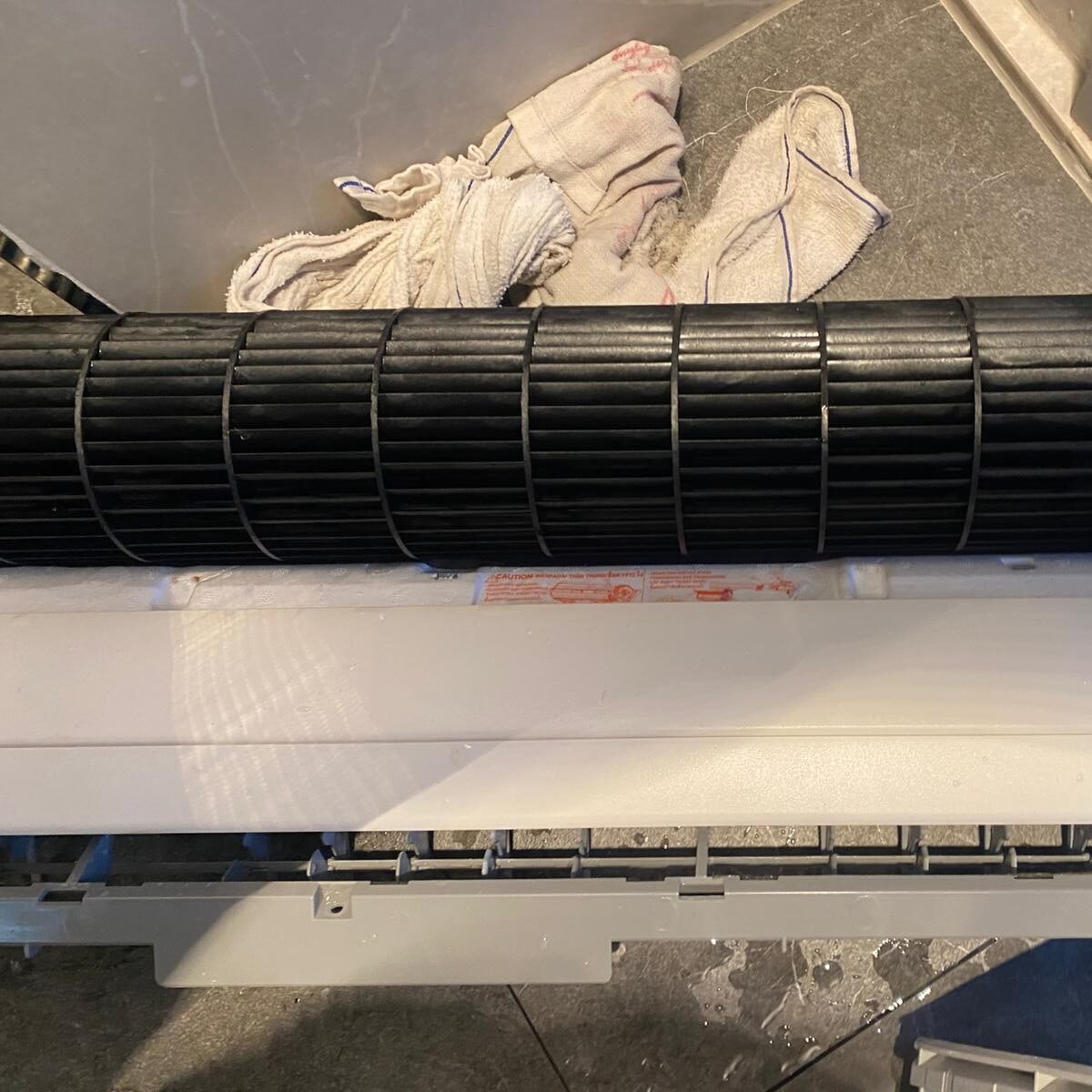
Dirty air filter
A clogged filter restricts airflow across the evaporator coil. Less air means less heat exchange, and the room stays warm even though the compressor is working.
In Singapore’s humidity, filters can clog faster than homeowners expect, especially in households with pets or near construction.
How to check:
- Power off the unit at the remote.
- Open the front panel of the indoor unit (most slide or clip up).
- Pull out the mesh filters. If they are grey, caked with dust or visibly blocked, that is the problem.
- Wash them under running water, let them dry completely, then reinstall.
- Run the unit in Cool mode and check airflow strength in 10 minutes.
If airflow improves but the unit still is not reaching temperature, there may be fouling deeper in the evaporator coil itself. That is where a chemical wash service helps.
A standard service wash cleans the filter and coil surface. If it has been more than a year since the last clean, or you see any visible mould on the vanes, a chemical wash is the more thorough option.
If neither of these resolve it within 24 hours, move to the next tier.
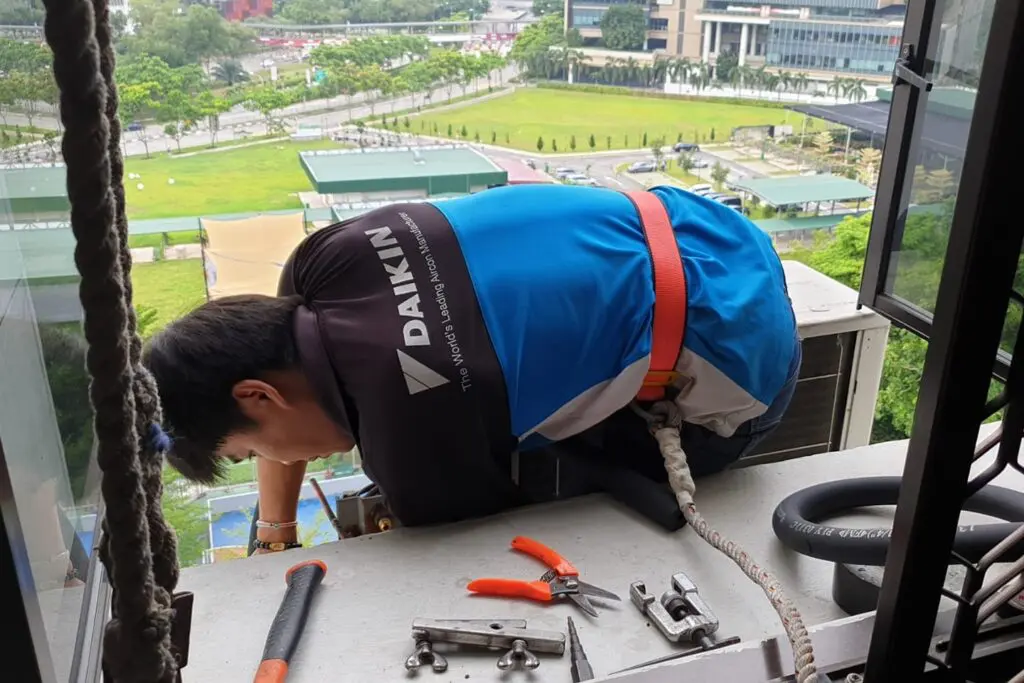
2. Call a technician this week: professional fixes needed
These causes are not emergencies in most cases. The unit can still run in the short term. But leaving them unattended for weeks will deepen the fault and increase the eventual repair cost.
Low refrigerant (gas leak)
Refrigerant is the substance that moves heat out of your room and releases it at the outdoor unit. If the level drops because of a slow leak, the system loses cooling capacity. The compressor keeps running but it cannot shift enough heat, so the room stays warm.
In most modern Singapore inverter systems, the refrigerant used is R32. This is a regulated substance. It requires trained handling, and topping up without first finding and fixing the leak source is pointless. The gas will simply escape again within weeks.
Signs your issue is likely low refrigerant:
- The unit runs continuously without reaching the setpoint
- The outdoor unit is running but airflow from the indoor unit feels weaker than normal
- The cold-then-warm pattern where the unit cools briefly then trails off
- You hear a faint hissing near the indoor or outdoor unit
A technician will pressure-test the system to locate the leak, repair it, then top up the refrigerant to specification. We cover aircon gas top up in Singapore as a dedicated service if you need to understand what is involved.
Dirty outdoor condenser coil
The condenser is the outdoor unit. Its job is to dump the heat extracted from your room into the outside air. When the coil fins get caked with dust, leaves, or grime, heat cannot escape efficiently, and cooling performance drops.
In Singapore’s HDB estates, outdoor units are often placed on ledges with limited clearance on multiple sides. Condensers in these placements with restricted airflow tend to foul faster and run hotter.
A dirty condenser is not dangerous in the way electrical faults are. But it makes the compressor work harder than it should, which shortens its lifespan over time. A technician will clean the condenser coil as part of a full service or a chemical wash that includes the outdoor unit.
If you can see the outdoor unit from your window, look for visible debris on the fins or any plants growing near the unit. If the fins look heavily coated, book a service.
For either of these faults, book an aircon repair in Singapore to get a technician to inspect and quote before the situation worsens.
3. Stop using the unit now: urgent faults that get worse with running
These are the faults where continuing to run the aircon actively compounds the damage. Over the years, the most expensive repairs we see are the ones that started as a cheap fault that was left running. A capacitor replacement is a fraction of the cost of a compressor replacement, but a failed capacitor left running can burn out the compressor within weeks.
If your symptoms match any of the causes below, power the unit off and book a technician promptly.
Frozen evaporator coil
The evaporator coil is inside your indoor unit. Under normal operation, it gets cold but stays above freezing. If airflow across it drops sharply (blocked filter, failed fan motor) or refrigerant is too low, the coil can drop below 0°C and ice over.
How to recognise it:
- Ice visible on the coils and copper pipes running to or from the indoor unit
- The unit cools the room for 20 to 30 minutes, then warm air returns
- You may notice water dripping near the indoor unit as ice melts during off cycles
Power the unit off at the wall. Do not keep cycling it on and off. As the ice melts, water can overflow the drain pan and cause water damage to your floor or walls. If you already notice water, check our guide to aircon leaking water for immediate steps.
Once thawed (give it an hour or two), a technician needs to identify whether the cause was restricted airflow or low refrigerant, and fix the root issue before the unit is used again.
Electrical faults: capacitor, PCB or wiring
Electrical faults cover a range of components: the start capacitor that helps the compressor and fan motor start under load, the printed circuit board (PCB) that controls the unit’s operation, and the wiring throughout.
Signs of an electrical fault:
- A buzzing or clicking sound from the outdoor unit, particularly on startup
- The circuit breaker for the aircon trips repeatedly
- The unit turns on but the compressor does not start (fan runs, no cooling)
- The display shows an error code (check your brand-specific error code guide for the exact fault)
Do not restart the unit if the breaker has tripped. Repeated tripping against an electrical fault risks arcing, which is a fire hazard. Power off at the isolator switch and call a technician.
A capacitor replacement is one of the more straightforward repairs. A PCB fault is more involved. Either way, a technician needs to diagnose which component has failed before any work is done.
Compressor failure
The compressor is the most expensive component in your aircon system. When it fails, the outdoor unit may run but produce no cooling at all. Sometimes, there is a grinding or rattling noise. Sometimes, it is silent.
Do not continue running the unit if you suspect compressor failure. Running a seized compressor draws excess current and can damage other electrical components.
If a technician confirms the compressor has failed, the repair cost needs to be weighed against the age of the system. For units under five years old, replacement is usually worth it. For older systems approaching 10 years, installing a new system may be the more practical decision. We can provide a price range for both so you can weigh your options.
Why Singapore’s climate makes this more common
The climate conditions here place extra load on aircon systems compared to other countries. The National Environment Agency (NEA) records average relative humidity between 70% and 90% for most of the year.
That moisture load means filters and evaporator coils foul faster than many aircon owners expect. Quarterly servicing is not a conservative schedule for Singapore. It is the appropriate one.
High ambient temperatures also reduce condenser efficiency. When outdoor air sits at 33°C or 34°C, the outdoor unit has less temperature difference to work with and runs harder as a result.
During prolonged hot spells, we see a clear spike in “not cold” calls. Systems running 10 to 12 hours a day expose marginal faults that would otherwise stay quiet. A refrigerant level that was just enough in a milder month becomes noticeably insufficient when demand is high.
If your unit is doing fine now but has not been serviced in over six months, book regular aircon servicing before the next heat wave hits, not after.
What to do next
The urgency tier, not the cause alone, determines your next move.
If your symptoms match Tier 1, run the settings and filter checks today. If the issue is resolved, great. If it is not resolved within 24 hours, a technician visit is the efficient next step.
If your symptoms match Tier 3, switch the unit off right now and book an aircon repair promptly. Continuing to run a frozen coil, an electrical fault or a failed compressor does not save time. It increases the repair bill.
To book an aircon repair in Singapore, you can reach our team Monday to Saturday, 9am to 11pm.
Frequently Asked Questions (FAQ)
1. How long can I keep running my aircon if it is not cooling?
It depends on the tier.
Tier 1 (settings, dirty filter) is safe to run while you carry out the checks.
Tier 2 (low refrigerant, dirty condenser) is manageable short-term but worsens over days and adds cost.
Tier 3 (electrical fault, frozen coil, compressor) means switching off immediately. Running a Tier 3 fault compounds the damage and turns a cheaper fix into a much more expensive one.
2. Why is my aircon cold at first, then warms up after 30 minutes?
The most common cause is the evaporator coil freezing mid-cycle. This happens because of low refrigerant or blocked airflow. Initial cooling works normally, then ice forms over the coil and blocks heat exchange entirely.
A secondary cause is an intermittent condenser fan fault. Either way, stop running the unit and book a technician. Continued cycling extends the damage.
3. How much does it cost to fix an aircon that is not cooling in Singapore?
A gas top-up runs around $75 to $120. Capacitor replacement costs $100 to $250. Compressor replacement is the highest repair cost and often prompts a comparison against replacing the full system.
Exact quotes will be provided upon inspection. Our $50 inspection fee is waived when you proceed with a service or repair.
4. Does an aircon service fix a warm aircon, or do I need a repair?
Service fixes fouling-based causes: a dirty filter, dirty evaporator coil and dirty condenser are all resolved through standard servicing or a chemical wash.
Repair fixes faults: refrigerant leaks, electrical component failure and compressor failure all need repair work.
Our technicians will diagnose which category your fault falls into during inspection, before any work begins.
5. Can I top up aircon gas myself?
No. Refrigerant systems are sealed and regulated. Topping up without locating and fixing the leak first means the gas escapes again within weeks.
R32, the standard refrigerant in modern Singapore inverter systems, requires trained handling and proper equipment to manage safely. A technician leak-tests the system, repairs the source, and then tops up to the correct specification.