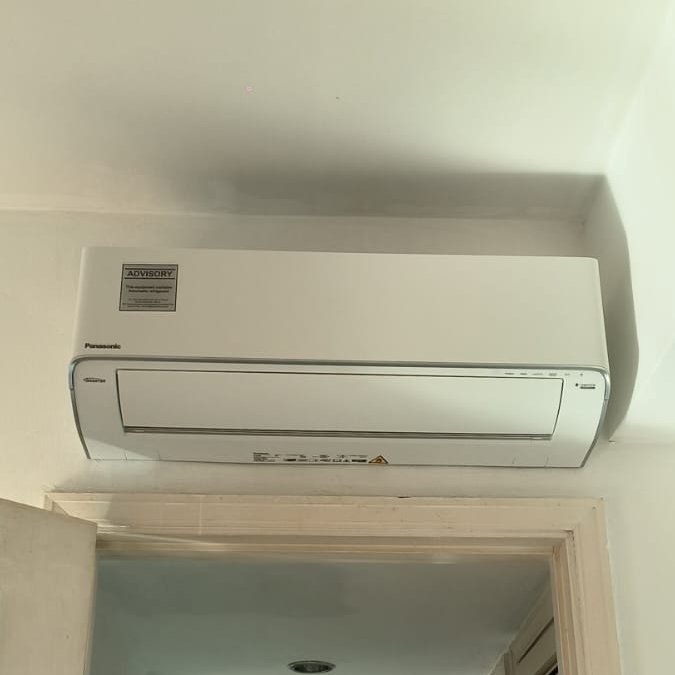
Your Panasonic aircon has stopped cooling properly and the timer light is blinking. You have no idea what’s wrong.
Here’s the thing. That blinking light can actually give you a clue to find out what’s wrong. Every Panasonic inverter unit has a self-diagnosis function built in, and it stores the exact fault code whenever something goes wrong. You just need to know how to retrieve it.
At Air Connection, we’ve been servicing Panasonic units across Singapore for 14 years. Here’s what the most common error codes mean, what you can try yourself, and when it’s time to call a technician.
Need immediate help to diagnose an error code? Whatsapp us at +65 96674287 for a free troubleshoot.
How to retrieve your Panasonic error code
The blinking timer light tells you something is wrong, but it doesn’t tell you what. The actual code is stored in the unit and you need to pull it out using the original Panasonic remote. Universal remotes won’t work for this.
Here’s how:
- Point your remote at the indoor unit.
- Find the small pinhole labeled CHECK on the remote. Use a straightened paperclip or SIM card tool to press and hold it for 5 to 8 seconds.
- The remote display will show “— —”.
- Press the timer up or down button to scroll through stored codes.
- When the indoor unit’s power LED lights up and you hear a long continuous beep, that’s your active error code. Write it down.
- Press the Cancel button to exit.
If you have a System 2, 3, or 4, check each indoor unit separately. Different units can show different codes.
Useful tip: If all your indoor units are blinking at the same time, the outdoor unit is likely the source of the problem. If only one unit is blinking, the fault is more likely in that indoor unit or its wiring. That distinction matters because outdoor unit repairs tend to cost more.
You can also check the Comfort Cloud app if your XU Series unit is connected to Wi-Fi. Active error codes show up in the notifications section.
The most common Panasonic error codes in Singapore
After attending to Panasonic service calls over the years, these are the codes we see most frequently in Singapore homes.
H11: Indoor and outdoor unit communication error
This is the number one Panasonic code we get called out for in Singapore. The two units have lost the ability to communicate with each other. It’s usually caused by loose wiring connections, a damaged signal cable, or a faulty PCB on either side of the system.
What you can try: Do a proper power reset. Switch off the circuit breaker (not just the wall socket), wait a full 10 minutes, then turn it back on. Never restart within a few minutes, as the system pressure hasn’t equalised and you risk damaging the compressor.
If H11 comes back after the reset, a technician needs to check the wiring and the control boards. PCB replacement for Panasonic units typically runs $300 to $450 depending on which board has failed.
H21: Drainage blocked
The drain pan inside your indoor unit has filled up and the safety float switch has cut power to the unit to stop water from overflowing. In Singapore’s 80 to 90% humidity, algae and slime grow inside drain lines fast. This is the root cause of most water leak complaints we attend to.
What you can try: Find the drain pipe outlet, which usually runs out to your toilet or service yard. Check for visible blockages at the end. Some homeowners have luck using a wet-dry vacuum to pull out the clog.
If water is already dripping from the unit, stop using it. The drain pan is full and continued running will make the overflow worse. A proper drain flush costs around $50 to $100 and clears the problem in most cases.
H99: Freeze protection activated
Your evaporator coil has gotten too cold, ice has started forming on it, and the unit has shut itself down to prevent damage. The most common cause is a clogged air filter restricting airflow across the coil.
What you can try: Clean your filters first. Open the front panel, slide out the mesh filters, wash them with mild soap and water, let them dry fully, then put them back. Restart the unit.
If H99 comes back even with clean filters, the unit is likely low on refrigerant gas. In that case, you will need a technician.
H98: Indoor unit overheating protection
The heat exchanger is running too hot because heat isn’t being removed from the room fast enough. The most common cause is again a dirty filter, but it can also happen if furniture or curtains are blocking the front of the indoor unit.
What you can try: Clean your filters and check that nothing is blocking airflow into or out of the unit.
F95: Outdoor unit high-pressure protection
The outdoor condenser is struggling to release heat because the coil is clogged with dust and debris. Singapore’s humidity means outdoor coils accumulate grime quickly. When they can’t shed heat properly, pressure inside the refrigerant circuit builds up and the unit shuts down to protect the compressor.
What you can try: Make sure the area around the outdoor unit is clear. Leaves, boxes, or anything sitting against the condenser will restrict airflow. If the coil itself looks dusty and grimy, it needs a professional clean.
F91: Refrigerant leak or low pressure
Your refrigerant level has dropped too low, either through a leak or because the charge was never quite right from installation. The system can’t operate and has shut down.
What you can try: Don’t keep running the unit with this code showing. Continued operation with low refrigerant puts serious strain on the compressor, which is the most expensive component to replace. A gas top-up runs around $75 to $120, but if there’s an active leak, the gas will escape again. We always recommend a pressure test to find the leak source.
H14, H27, H28: Temperature sensor faults
These codes all point to a faulty thermistor, a small temperature sensor, that has either shorted out or lost its connection. The unit can’t read temperatures correctly and shuts down as a precaution.
What you can try: You can’t do much for these yourself. Sensor replacement is usually straightforward for a technician and costs somewhere in the $70 to $150 range depending on which sensor has failed.
H19 and H97: Fan motor lock (indoor and outdoor)
The fan motor has stopped spinning when it should be running. H19 is the indoor unit fan and H97 is the outdoor unit fan. Causes range from debris in the fan blades to a faulty motor or PCB.
What you can try: Switch off the unit and call a technician. Running a unit with a locked fan will overheat other components quickly.
Other Panasonic codes you might see
| Code | Meaning | What to do |
|---|---|---|
| H12 | Capacity mismatch between indoor and outdoor units | Technician required, usually a system design issue |
| H16 | Low current detected, often linked to low refrigerant | Technician required |
| H33 | Wiring error between indoor and outdoor units | Technician required |
| F97 | Compressor overheating | Switch off. May self-reset once, but call a technician if it returns |
| F99 | Outdoor DC protection error | Serious issue. Switch off and call a technician |
| H67 | nanoe X unit malfunction | Technician required |
Common Panasonic problems that don’t always show a code
Some faults don’t always trigger an error code, but they’re just as common.
1. Aircon not cold enough
Start with the filter. A clogged filter is the cause in more cases than most people expect. If cleaning the filter doesn’t help and the unit has been running for more than a year, the gas level may have dropped.
We also see cases where the ECONAVI sensor in newer Panasonic units is incorrectly throttling the compressor in a room it’s misreading. A technician can verify this quickly.
2. Water dripping from the indoor unit
Singapore’s humidity makes this the single most common Panasonic complaint we handle. Algae block the drain line, the pan overflows, and water ends up on your floor or walls.
Quarterly servicing prevents most of this. If it’s already leaking, stop running the unit and get the drain cleared.
3. Musty or mouldy smell
Mould grows fast inside blower wheels and evaporator coils in our climate. If your unit has the Inside Clean function (press and hold the nanoe X button for 3 seconds after switching off), run it regularly. It won’t replace a proper chemical wash, but it helps between services.
If the smell is persistent or strong, a chemical wash is the right fix.
4. Unit keeps switching off by itself
If the unit runs for 10 to 15 minutes and then cuts out, check the circuit breaker first. If the breaker is fine, the unit is likely triggering freeze protection from low gas or a dirty filter, or there’s a fault in the outdoor PCB that needs diagnosing.
When to DIY and when to call us
Safe to try yourself:
- Wash the air filters
- Do a full power reset at the circuit breaker, waiting 10 minutes before restarting
- Clear debris and check airflow around the outdoor unit
- Check and vacuum the drain pipe outlet
- Reset the remote using the pinhole at its base
Call us soon:
- Error code returns after a power reset
- Weak cooling even after cleaning the filters
- Water dripping from the indoor unit
- H11, H21, F91, or F95 that won’t clear
Switch off and call us right away:
- F91 or any code you suspect is a refrigerant leak
- F99 or any compressor protection code
- Burning smell from the unit
- Circuit breaker tripping more than once
- Water dripping heavily
Still stuck? We can help.
If your Panasonic is showing a fault code you can’t clear, send us a WhatsApp message with the code and we’ll give you an honest read on what’s likely wrong before we come down.
We’ve been servicing Panasonic units across Singapore for 14 years. With a team of 60 technicians, we can usually get to you the same day or next day. We’ll tell you what we find and what it costs before we start any work.