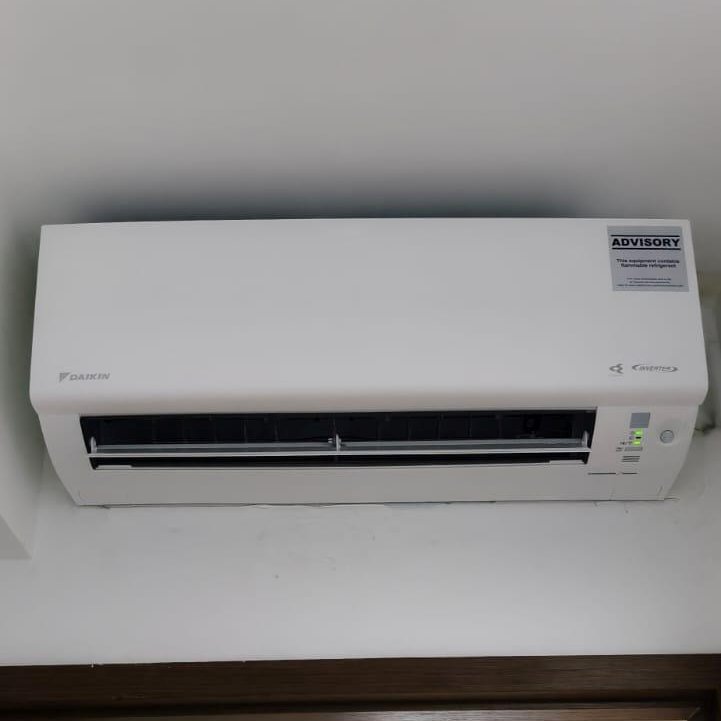
Your Daikin aircon just stopped working properly, the light is blinking, and it’s 33°C outside. We get it. Before you panic, take a breath. Most Daikin error codes have a clear cause, and some you can even fix yourself in a few minutes.
At Air Connection, we’ve been servicing Daikin units across Singapore for 14 years. In that time, we’ve seen every error code Daikin throws out. Here’s what the most common ones mean, what you can try at home, and when it’s time to call us in.
Need immediate help to diagnose an error code? Whatsapp us at +65 96674287 for a free troubleshoot.
How to check your Daikin error code
When your indoor unit starts blinking, it’s telling you something is wrong. But the blinking light alone doesn’t tell you what. You need to pull the error code using your original Daikin remote. Universal remotes won’t work for this.
Here’s how to do it:
- Point the remote at your indoor unit.
- Press and hold the Cancel (Timer Cancel) button for about 5 seconds.
- The display will show “00” and start blinking.
- Press the Cancel button again to cycle through codes.
- Listen carefully. A short beep means that’s not your code. A long continuous beep means you’ve found it. Write it down.
- To exit, hold Cancel for 5 seconds or wait 1 minute.
If you have a System 2, 3, or 4, check each indoor unit separately. Different units can show different codes.
Quick guide to the blinking lights:
- Green blinking: General error detected. Use the remote to get the code.
- Orange blinking: Indoor unit issue. Often a sensor or Streamer unit needs cleaning.
- Red blinking: Serious fault. Turn off the unit and call a technician.
For the full official reference, Daikin’s global error code chart is available here.
The 7 most common Daikin error codes in Singapore
After servicing thousands of Daikin units across HDB flats and condos, these are the codes we see most often.
U4: Indoor and outdoor unit communication failure
This is the number one Daikin code we get called out for. Your indoor and outdoor units have stopped talking to each other. It’s often caused by PCB (circuit board) issues, which tend to happen more in older HDB estates where voltage fluctuations are common.
What you can try: Switch off the aircon at the isolator for 60 seconds, then turn it back on. Sometimes a power reset clears it.
If the issue persists, a Daikin-trained technician can test the wiring and PCB. Replacement costs typically run from $150 to $900 depending on which board is faulty.
E7: Outdoor fan motor malfunction
The fan on your outdoor condenser isn’t spinning properly. In Singapore, this often happens because leaves, dust, or debris get lodged in the fan blades, especially after heavy rain.
What you can try: If you can safely see the outdoor unit, switch off the power and check for visible debris. Clear anything blocking the fan.
If the fan still won’t spin, the motor likely needs replacing. For a System 3, expect around $280 for a refurbished motor with installation.
U0: Low refrigerant (gas shortage)
Your aircon is blowing air but it’s not cold, and you’re seeing a U0 code. This almost always means a refrigerant leak somewhere in the piping.
What you can try: Nothing you can DIY here. Refrigerant handling needs proper tools and licensing.
A gas top-up runs around $70 to $120. But here’s the honest truth: if your gas leaked out once, it will leak again. We always recommend a pressure test to find the leak source. Otherwise you’ll be topping up every few months.
A3: Drain level abnormality
Water has built up in your indoor unit’s drain pan because the drain pipe is blocked. With Singapore’s 80 to 90% humidity, we see this constantly. Algae and slime grow inside drain lines all year round.
What you can try: Locate the drain pipe outlet (usually runs out to your toilet or service yard). Check if it’s clogged at the end. Some homeowners have luck using a wet-dry vacuum to suck out the blockage.
If that doesn’t work, a proper drain flush costs around $50 to $100.
A5: Freeze-up protection activated
Your evaporator coil has dropped below freezing and the unit has shut down to protect itself. The number one cause? A dirty air filter restricting airflow.
What you can try: Open the indoor unit’s front panel, remove the filters, wash them with mild soap and water, let them dry fully, then put them back. Restart the unit.
If A5 comes back even with clean filters, you likely have a thermistor fault. Call a technician for that one.
F3: High discharge pipe temperature
Your compressor is running hotter than it should. This usually points to low refrigerant, a clogged pipe, or a faulty thermistor.
What you can try: F3 isn’t a DIY fix. Running the unit with this error can damage the compressor, which is the most expensive part of your aircon. Switch it off and get it checked.
E5: Compressor overheat or lock
This is the serious one. Your compressor is either overheating or mechanically stuck. Keep running it and you risk permanent damage.
What you can try: Switch off the unit at the isolator. Don’t try to fix this yourself. Compressor repairs start around $500 and replacement can cost significantly more. A proper diagnosis is essential before spending that kind of money.
Other Daikin codes you might see
| Code | Meaning | What to Do |
|---|---|---|
| A1 | Indoor PCB defect | Technician required |
| A6 | Indoor fan motor fault | Technician required |
| C4 | Indoor thermistor fault | Technician required |
| J3 | Discharge pipe thermistor fault | Common after 7 to 8 years. Technician required |
| J6 | Heat exchanger thermistor fault | Common after 7 to 8 years. Technician required |
| L5 | Inverter overcurrent | Serious issue. Switch off and call a technician |
| LC | Control and inverter PCB communication failure | Technician required |
| UH | System malfunction | Usually multi-split wiring or unit mismatch. Technician required |
For the complete list of every Daikin error code, refer to Daikin’s official SM-TS3 error code chart.
Common Daikin problems that don’t show a code
Sometimes your aircon misbehaves without flashing any code at all. Here are the ones we handle most often.
1. Not cold enough
Usually dirty filters or coils. Clean your filters first. If that doesn’t help, your unit probably needs a chemical wash. We’ve seen 1mm of dust on a coil raise electricity use by over 20%.
2. Water leaking from indoor unit
More than 60% of leaks we attend to are caused by a clogged drain pipe. Singapore’s humidity is relentless on drain lines. If you can’t clear it yourself, we can flush it out for you.
3. Bad smell when you switch on
That musty smell is mould and bacteria growing inside your unit, thanks again to our humidity. A chemical wash is the proper fix. General servicing won’t remove deeply embedded mould.
4. Strange noises
A short gurgling sound after you switch off is normal, that’s just refrigerant settling. But continuous buzzing, hissing, or grinding is not normal. Hissing especially can point to a refrigerant leak and should be checked quickly.
If any of these persist after you’ve tried the basics, contact our technicians to take a proper look.
When to DIY and when to call us
Safe to try yourself:
- Wash the air filters
- Clear visible debris from the outdoor unit (if you can reach it safely)
- Power reset at the isolator for 60 seconds
- Check and clear the drain pipe outlet
Call us soon:
- Error code keeps coming back after a reset
- Weak cooling even with clean filters
- Persistent water leaking
- U4, E7, U0, A3 codes that don’t clear
Switch off and call us right away:
- Red blinking light
- E5, L5, or any compressor-related code
- Burning smell
- Circuit breaker tripping repeatedly
Still stuck? We can help
If your Daikin is still showing an error code after you’ve tried the steps above, send us a WhatsApp message with the code and a photo of your unit. We’ll tell you what’s likely wrong and give you an honest idea of the cost before we come down.
We’ve been fixing Daikin aircons across Singapore for 14 years. With a team of 60 technicians, we can usually get to you the same day or next day. No surprises, no upselling, just practical help from people who actually know these units.